back
REVENUE AGENT

Joshua Sum
Founder, Morphic
8 min read

Keep deals moving with unified context, a clear sales process, and your team in control.
Your team has already done the work to create the opportunity: prospecting, discovery, demos, and technical conversations.
Your bottleneck for scaling revenue is not lead generation. It's the deals that die in the pipeline.
Research published in Harvard Business Review found that 40–60% of deals ended without a purchase despite expressed buying intent.
Ebsta and Pavilion’s 2025 GTM Benchmarks Report also found that 44% of contacts never made it into the CRM. Of those missing contacts, 26% were decision-makers.
That’s why we built the Morphic Revenue Agent: an AI agent that brings together context across your existing go-to-market tools, helps execute your sales process, and keeps people involved in the decisions that move deals forward.
View our Launchhere
What a Revenue Agent Actually Does
A revenue agent is an AI assistant that can autonomously start workflows to help you with your sales and revenue operations. It can interpret customer information, decide which permitted step to take and act across business systems.
Also called RevOps Agents at times, spans across sales, marketing, customer success and sometimes even finance. The goal is straightforward: keep every active opportunity aligned with the latest evidence, with a clear owner and next step.
A product-led company and an enterprise security vendor should not be forced into the same pipeline. Below is an illustrative adaptation of a six-stage B2B process, with evidence required to leave each stage.

Keep your CRM and Connect the work around it
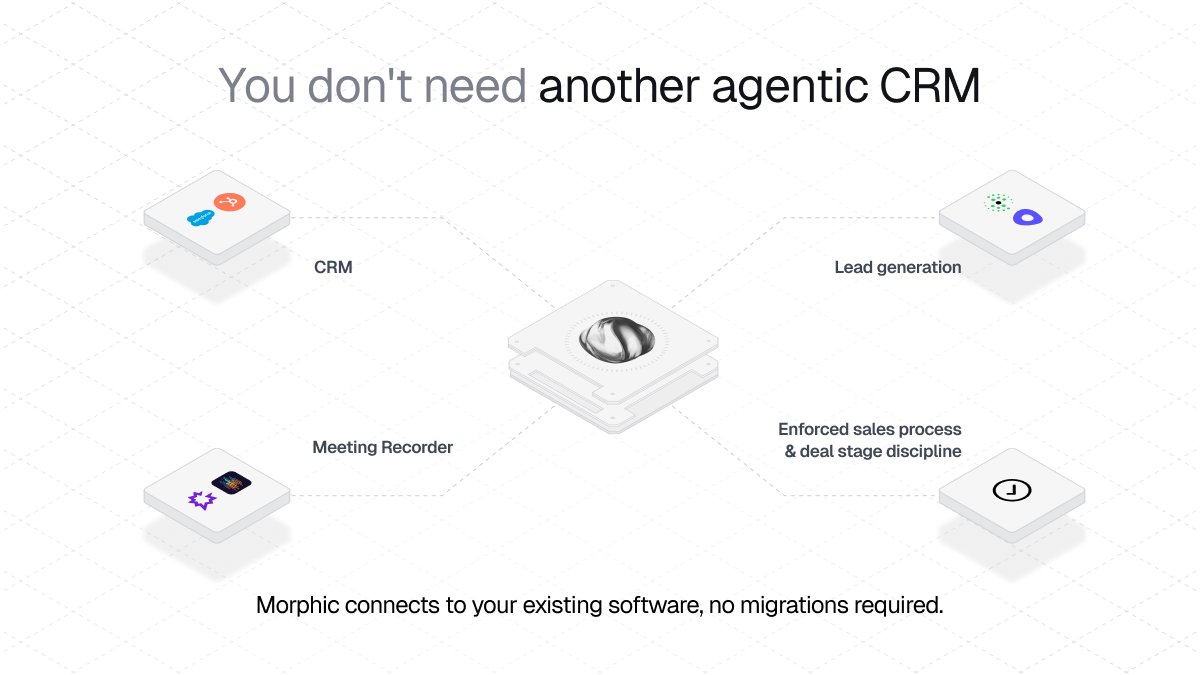
Your CRM is the source of truth for your revenue operation. You do not need to move to another platform. Moving it means disrupting the records, workflows, and habits your team already relies on.
Instead, Morphic connects to your existing software, including your CRM, outbound tools, and meeting recorder. It brings the information around a deal into the workflow your team already uses, helping keep records current and next steps visible.

Turn your sales process into Routines
A product-led company and an enterprise security vendor should not be forced into the same pipeline. Their buyers, approval processes, and requirements for moving a deal forward are different.
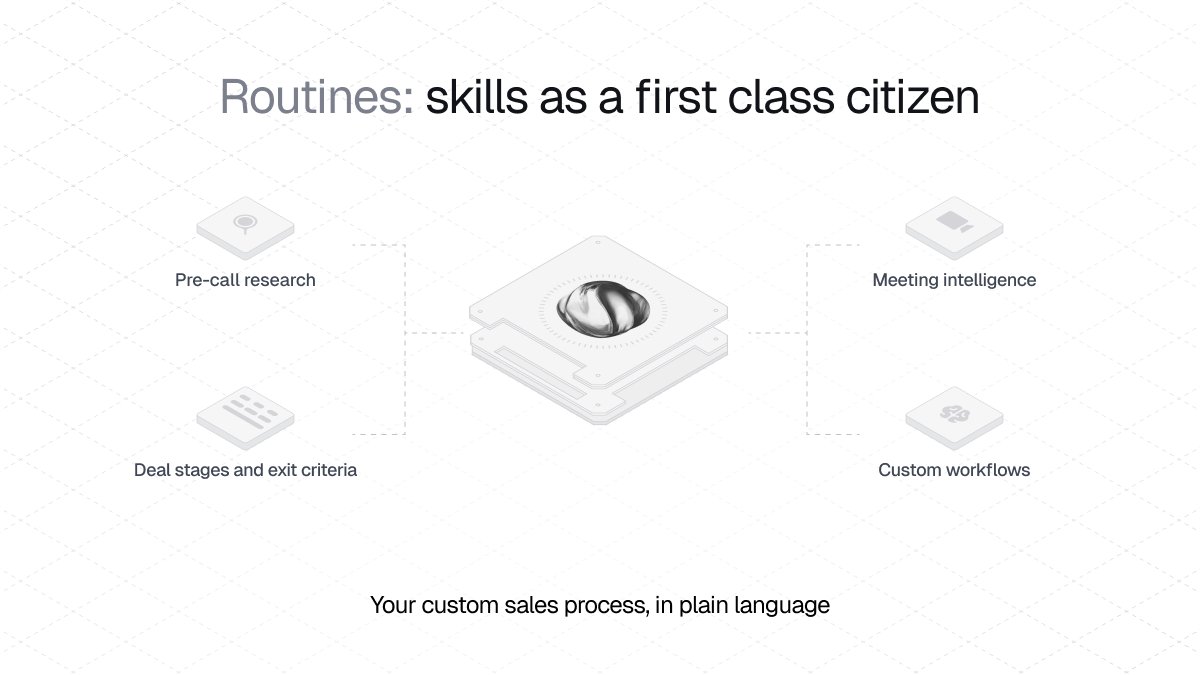
Routines let you define your sales process in plain language. They give Morphic instructions for recurring work, from preparing for a conversation to checking whether an opportunity meets the criteria for its next stage.
You can define Routines for:
Pre-call research: bring together the account and deal context a rep needs before a meeting.
Meeting intelligence: capture commitments, questions, and blockers from customer conversations.
Follow-up drafts: prepare the next message based on what was discussed.
Deal stages and exit criteria: specify the evidence required before an opportunity can advance.
Custom workflows: reflect the way your team actually sells.
A clear Routine makes that distinction actionable. The next step is to resolve the review, establish who owns it, and confirm the timing. The process gives the team a shared definition of progress.
Every deal produces knowledge: which concerns delayed a decision, why a discount was approved, what a buyer needed before moving forward, and how the team responded.
Morphic is designed to learn continuously as you refine your sales process. Your own past deals become the reference point for improvement, reflecting your customers, product, and way of selling.
You own the customer interactions, decision traces, human approvals, and business context generated along the way.
This is where the record behind an action matters. A useful agent trace connects the event that triggered work to the steps performed and their results. It helps a team inspect what happened and identify what needs to improve.
For the budget-approved deal with an outstanding security review, that record can help distinguish a misunderstood message from a poorly defined stage rule. Those are different problems, and they need different corrections.
Over time, the lessons from those corrections can inform clearer Routines and a more consistent sales process.
Human in the loop
When a revenue agent makes sense
Morphic is a fit when you’re scaling sales, expanding each rep’s capacity, and finding that revenue operations work is taking time away from selling.
Your process should also be stable enough to write down. An agent needs a clear workflow to follow and a team that can judge whether the outcome is right.
Start with one recurring motion, such as post-meeting updates and follow-up drafts. Establish a baseline, review the results, and measure whether the workflow reduces administrative effort while keeping opportunity information accurate.
Look at whether deals have current next steps, how often reps need to correct the agent, and whether the team has more time for customer conversations. Use those results to decide where to expand.
Morphic is built to support your people and increase their capacity. Human expertise remains central to the sales process.

Recap of what Morphic Offers
 | Unified Context from Existing Stack Morphic grabs context throughout your existing GTM softwares and tools you’re familiar with and proactively updates your CRM so even when you forgot something, Morphic wont |
 | Refine and automate your sales process
|
 | Proactive Agents Morphic observes every thread, meetings, and deal status so when the conversation changes, your agents can suggest next actions, ensuring your sales rep never let a deal go stale |
 | Solo Source of Truth Shared Markdown knowledge that constantly updates and gives every agent the context to understand your company, products, and processes |
Book a demo with us to see how Morphic can work with your existing GTM stack and we will walk through your current pipeline to evaluate the best set up for your team
Sources & further reading
1. Dixon, Matthew, and Ted McKenna. Stop Losing Sales to Customer Indecision.
Harvard Business Review, June 24, 2022.
2. Ebsta. Highlights of 2025 GTM Benchmarks.
Published benchmark highlights: deal slippage and missing CRM contacts.
3. Ebsta & Pavilion. 2025 GTM Digest: Sales Efficiency.
Printed p. 1: dataset; printed p. 9: win rates by slippage duration.
4. IBM Think. AI Agents and RevOps.
RevOps applications, data foundations, workflow design and gradual rollout.
5. DealHub. What Is Agentic Revenue?
Revenue workflows, human oversight and operational guardrails.
6. Anthropic. Effective Context Engineering for AI Agents.
Retrieval and persistent memory for context management.
7. Anthropic. Building Effective Agents.
Architectural distinction between predefined workflows and dynamic agents.
8. Amazon Builders' Library. Making Retries Safe with Idempotent APIs.
Designing retry behavior that avoids duplicate side effects.
9. OpenTelemetry. Traces.
Trace and span concepts and relationships.
10. Chase, Harrison. LangChain. Agent Observability Powers Agent Evaluation.
January 27, 2026. Using traces to debug and evaluate agents.
11. Morphic. Revenue Agent.
Public product capabilities, supported channels and sales-stage discipline.
Human in the loop
Sales depends on relationships, timing, and judgment. Morphic handles recurring work with your team involved in approvals.
No deal stage changes without confirmation from the sales rep.
Exit criteria establish what needs to be true for a deal to advance. Rep confirmation provides the human checkpoint before that change happens. Together, they help keep the pipeline aligned with both the evidence and the person responsible for the opportunity.
Morphic helps reps manage the process while they retain control over the decisions that matter.

An opportunity record is only one part of the customer story. Understanding a deal also means understanding the organization, its priorities, and the people involved in a purchase.
Morphic’s deal intelligence brings together signals such as headcount, job postings, and social media activity. It helps map the organizations you’re selling into and track the customer journey from initial outreach through a signed deal.