back
WORKSPACE

Joshua sum
Founder, Morphic
8 min read

We’re excited to announce the release of our workspace here at Morphic. In the content below, we will explore what an AI-native workspace is, the difference between traditional workspaces and agentic workspaces, and whether it's the right fit for you.
What is an agentic workspace?
An agentic workspace is a single system that holds your company's knowledge, tasks, records, meetings, and workflows in one data layer, with AI agents operating natively inside that layer.
> SFDC's 2026 research found 51% of sales leaders say disconnected systems slow AI initiatives
Every company selling AI into go-to-market is solving for faster execution on individual tasks yet few are solving for a unified integrated system. Sure an API can provide access to applications, but access alone does not establish shared meaning, reliable state, or coordinated execution. To achieve that, one would need to rebuild the entire system underneath, not bolting an assistant onto it. That’s what we do at Morphic.
How this differs from other CRM platforms like Salesforce and HubSpot

While they may seem similar, traditional workspaces are more focused on
CRM platforms organize customer relationships through contacts, accounts, opportunities, activities, and reporting. Agentic workspaces extend the working environment around those records to include the knowledge and execution needed to move a customer relationship forward.
The categories overlap. Describing either platform as a passive database or a system whose agents can only read CRM fields would be inaccurate. [2, 3]

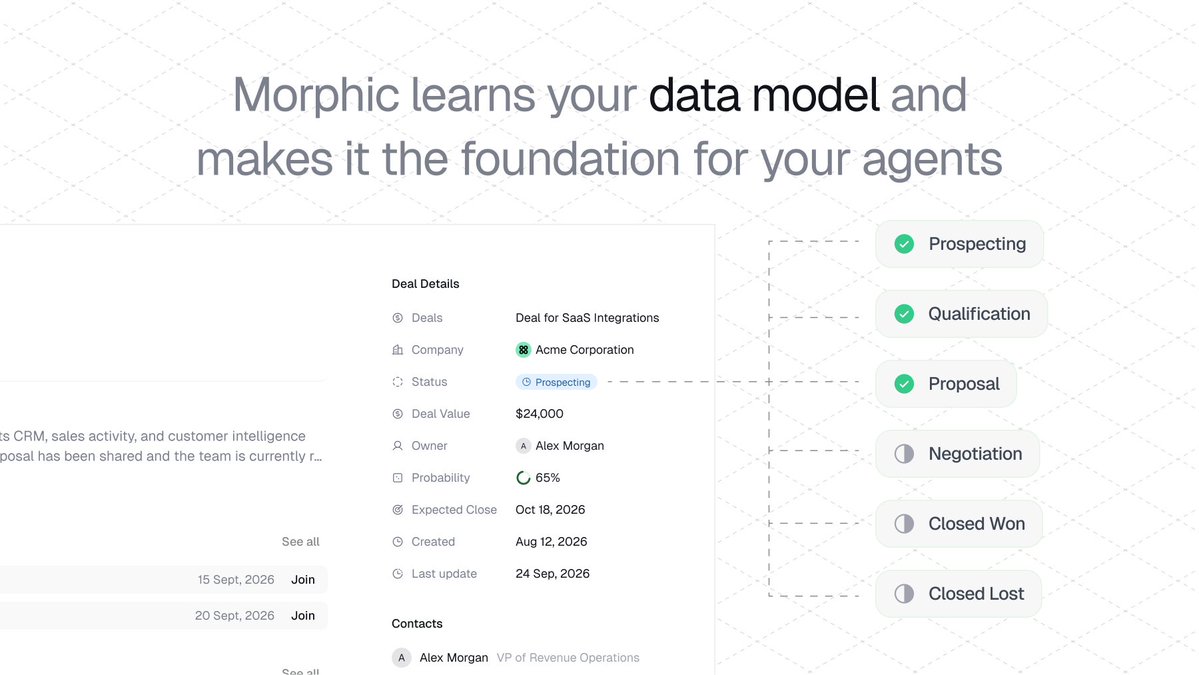
Morphic’s proposition is to bring more of the surrounding work into one workspace. Behind the workspaces, Morphic's core engine automatically learns your ontologies and context so your team and agents don't have to work with rigid schemas or stale data Model the way your team actually operates - simply on Morphic and by connecting software you use
3. A glimpse inside Morphic’s Workspace
Morphic is a home base where anyone, technical or not, can command AI with unified context across
 | Knowledge Base Shared Markdown knowledge that gives every agent the context to understand your company, products, and processes. |
 | Project Management Plan projects, assign ownership, and track progress without switching tools. Work alongside Revenue Agents to help you remind you and complete tasks. |
 | Records and Tables Structured company data covering customers, projects, assets, and internal data in flexible records according to your own defined ontologies. |
 | Meeting Transcription Automatic recording, summaries, and suggests action items following the conclusion of meeting |
and more. With one-click agents you can spin up and tag your agent on Slack
Choosing between traditional and agentic Workspaces
Choosing between traditional and agentic Workspaces

The CRM won because it was the first system that made customer relationships legible to a company at scale. It earned its position. But it was built for humans reading records, and the constraint it was designed around, that a person can only hold so much in their head, is not the binding constraint anymore.
The binding constraint now is context. An agent can read every document, transcript, record, and thread your company has produced. Whether it does depends entirely on whether those things live somewhere it can reach. That is an architecture decision, and it is being made right now at most companies by default rather than on purpose.
The question worth asking is not which vendor has better agents. Within a year, everyone's agents will be roughly comparable, because they are running on the same underlying models. The question is which system will have the context those agents need. That advantage compounds, and it does not transfer.
If you are rethinking where your company's context should live, we should talk. Book a demo and we will walk through your current stack and where the seams are.